|
||||
Global Warming FAQ
Watch Our Videos
How do we know that humans are the major cause of global warming?The Fourth Assessment Report of the Intergovernmental Panel on Climate Change (IPCC) states: it is a greater than a 90 percent certainty that emissions of heat-trapping gases from human activities have caused “most of the observed increase in globally averaged temperatures since the mid-20th century.” We all know that warming—and cooling—has happened in the past, and long before humans were around. Many factors (called “climate drivers”) can influence Earth’s climate—such as changes in the sun’s intensity and volcanic eruptions, as well as heat-trapping gases in the atmosphere. So how do scientists know that today’s warming is primarily caused by humans putting too much carbon in the atmosphere when we burn coal, oil, and gas or cut down forests?
Figure 2. Twentieth Century History of Climate Drivers
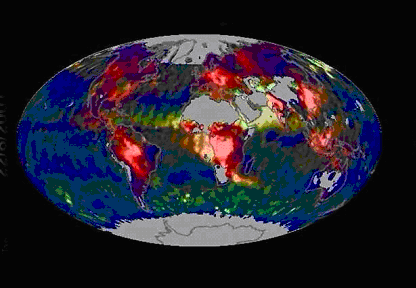
Explore more about humans' role in global warming. Why does CO2 get most of the attention when there are so many other heat-trapping gases (greenhouse gases)?Global warming is primarily a problem of too much carbon dioxide in the atmosphere. This carbon overload is caused mainly when we burn fossil fuels like coal, oil and gas or cut down and burn forests. There are many heat-trapping gases (from methane to water vapor), but CO2 puts us at the greatest risk of irreversible changes if it continues to accumulate unabated in the atmosphere. There are two key reasons why. CO2 has caused most of the warming and its influence is expected to continue. CO2, more than any other climate driver, has contributed the most to climate change between 1750 and 2005.[1, 2, 3] The Intergovernmental Panel on Climate Change (IPCC) issued a global climate assessment in 2007 that compared the relative influence exerted by key heat-trapping gases, tiny particles known as aerosols, and land use change of human origin on our climate between 1750 and 2005.[3] By measuring the abundance of heat-trapping gases in ice cores, the atmosphere, and other climate drivers along with models, the IPCC calculated the “radiative forcing” (RF) of each climate driver—in other words, the net increase (or decrease) in the amount of energy reaching Earth’s surface attributable to that climate driver. Positive RF values represent average surface warming and negative values represent average surface cooling. CO2 has the highest positive RF (see Figure 1) of all the human-influenced climate drivers compared by the IPCC. Other gases have more potent heat-trapping ability molecule per molecule than CO2 (e.g. methane), but are simply far less abundant in the atmosphere and being added more slowly. Figure 1. How Does CO2 Compare To Other Climate Drivers? Explore more about CO2 and other heat trapping gases. What is the latest climate science?Major developments in climate change science have been reported since the publication of the comprehensive 2007 Fourth Assessment Report (AR4) of the Intergovernmental Panel on Climate Change (IPCC).[1] Recent publications indicate that the consequences of climate change are already occurring at a faster pace and are of greater magnitude than the climate models used by the IPCC projected. A few of the most compelling findings are summarized below. More CO2 Remains in the Atmosphere Figure 1. Today’s Ton Is Worse Than a Ton Emitted Decades Ago Explore more about the latest climate science. Does air pollution—specifically particulate matter (aerosols)—affect global warming?Air pollution occurs when the air contains gases, dust, fumes or odor in harmful amounts—aerosols are a subset of air pollution that refers to the tiny particles suspended everywhere in our atmosphere. These particles can be both solid and liquid and are collectively referred to as ‘atmospheric aerosol particles’ [1]. Most are produced by natural processes such as erupting volcanoes, and some are from human industrial and agricultural activities (see Figure 1). Those particles in the lowest layer of the atmosphere, where our weather occurs, usually stay relatively close to the source of emissions and remain in the atmosphere only a few days to a week before they fall to the ground or are rained out; those higher up in the atmosphere travel farther and may linger in the atmosphere for a few years. Light-colored aerosol particles can reflect incoming energy from the sun (heat) in cloud-free air and dark particles can absorb it. Aerosols can modify how much energy clouds reflect and they can change atmospheric circulation patterns—in short, aerosols can modify our climate [2]. Several climate engineering (so-called ‘geoengineering’) strategies for reducing global warming propose using atmospheric aerosol particles to reflect the sun’s energy away from Earth. Because aerosol particles do not stay in the atmosphere for very long—and global warming gases stay in the atmosphere for decades to centuries—accumulated heat-trapping gases will overpower any temporary cooling due to short-lived aerosol particles. Figure 1. Small Particles (Aerosols) in the Atmosphere
Small particles suspended in the Earth’s atmosphere (aerosols) include fine aerosols such as pollution and smoke (red) and coarse aerosols such as dust and sea-salt (green). Image shows aerosol levels on April 13, 2001 as seen by a NASA satellite. Source: NASA Explore more about air pollution and global warming. How does the sun affect our climate?The sun is the source of most of the energy that drives the biological and physical processes in the world around us—in oceans and on land it fuels plant growth that forms the base of the food chain, and in the atmosphere it warms air which drives our weather. The rate of energy coming from the sun changes slightly day to day. Over many millennia in the Earth-Sun orbital relationship can change the geographical distribution of the sun’s energy over the Earth’s surface. It has been suggested that changes in solar output might affect our climate—both directly, by changing the rate of solar heating of the Earth and atmosphere, and indirectly, by changing cloud forming processes. Over the time-scale of millions of years the change in solar intensity is a critical factor influencing climate (e.g., ice ages). However, changes in solar heating rate over the last century cannot account for the magnitude and distribution of the rise in global mean temperature during that time period and there is no convincing evidence for significant indirect influences on our climate due to twentieth century changes in solar output. |
||||